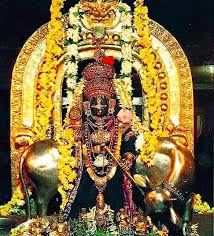
The holy town of Udupi lies on the
Arabian Sea in the state of Karnataka. The town is famous as a place of
pilgrimage because of the temple Sri Krishna Matha. This temple was founded by
Sri Madhvaacaarya (A.D. 1238–1317), one of the greatest saints, philosophers,
and religious reformers of India.
Udupi is said to have attained the
status of Vaikuntha, the kingdom of God, because the Supreme Personality of
Godhead came and stayed there in response to the desire of His pure devotee Sri
Madhvaacaarya.
The unique feature of Shree Krishna
Matha temple is that the Lord is worshipped only through a window with nine
holes called the Navagraha Kindi. The window is exquisitely carved and silver –
plated. It has been a tradition in this temple to worship the Lord only through
this window.
Even before Madhva's time, Udupi was
renowned as a holy place. People throughout South India frequently went there
on pilgrimage because it was a center of Vedic scholarship and the site of two
ancient temples, Sri Ananteshvara and Sri Candramauleshvara.
• Land of Parashuram
Lord Vishnu, in his sixth incarnation
as Parashurama, after making twenty one assaults on Kashtriyas deviated from
the path of religion, performed a great yajna and donated all the land he won,
he was left with no land for himself.
Unwilling to stay in the land already
gifted, he reclaimed a strip of land from the Arabian Sea. This coastal strip
of land, from Gokarna to Kanyakumari is known as Parashurama Kshetra.
Ramabhoja, a great devotee of Lord
Parashurama was proclaimed the king of Parashurama Kshetra intending to perform
a maha yajna, he got the site for the sacrificial fire ploughed up. A serpent
got into the plough and got killed. Although the serpent was a demon in
disguise, the king was worried, as it was a sin to kill a serpent. To atone
this sin, he was directed by Lord Parasurama to build a big silver podium with
the image of a serpent at each of its four corners and to worship him who would
be seated in spirit on the podium and also to distribute gold equal to his own
weight (Tulabhara) to deserving persons.
Rambhoja did likewise and performed
the Ashwamedha Yajna successfully. At its conclusion, Lord Parasurama appeared
and declared that he was pleased with the Yajna and that henceforth the
sacrificial land 'Rajatha Peetha' (silver pedestal) would become a famous
centre of pilgrimage. This land is also known as 'Thoulava' land because Rambhoja
performed 'Tulabhara'.
The king Ramabhoja also built four Durgalayas (Durga temple) and
Nagalayas (Subramanya temple) one each in each direction.
• Shri Anantheshwar
In that place Lord Shiva appeared in the form of Linga and occupied the
silver pedestal. It was on the request of Lord Shiva that Lord Parashurama also
enshrined within the Linga – the form of Lord Anantha also and hence the name
Anantheshwara was given to this unique Linga.
Built during the seventh or eighth
century A.D., the temple's existence is recorded in an inscription dated 1357
A.D. and the deity in it has been referred to as Sri Mahadeva of Udupi. With
spacious interiors, it was an important centre of learning then. Sri
Madhwacharya is said to have studied under Sri Achyuta Prajna during his
childhood. He took his “sanyasa deeksha” here. The acharya used to teach his
disciples here.
The “peetha” on which Sri
Madhwacharya is preserved. Prayers are offered to the “peetha” daily. Sri
Vadiraja Swamiji is said to have installed a statue of Sri Madhwacharya. The
“mukhamantapa,” “navaranga”, and “garbagriha” or the sanctum sanctorum of the Anantheshwara
Temple are known for their unique architecture.
The Shri Anantheshwara Temple has
been a seat of learning since time immemorial for the study of Veda, Vedanta,
Upanishads. It was this place where Shri Madhwacharya obtained lessons from his
Guru Shri Achyuthaprekshacharya. The details of Anantheshwara appear in the
Shri Skandapurana.
Srila Madhvaacaarya, in the years
before he founded the Sri Krishna Matha, was affiliated with the Sri
Anantesvara temple. Here he used to hold audiences mesmerized with his learned
discourses on the science of Krishna awareness. Within the temple compound he
would regularly hold debates with scholars opposed to pure devotion to Lord
Krishna as the ultimate end of Vedic knowledge. Madhva never lost a debate.
After founding Sri Krishna Matha,
Madhva made it the center for all his activities. Tradition still has it,
however, that pilgrims go first to Candramaulesvara and offer their respects to
Lord Shiva, then to Anantesvara to offer respects to Lord Vishnu, and finally
go across the street to Sri Krishna Matha to worship Sri Madhvaacaarya's
original Deity of Lord Bal Krishna, the Supreme Personality of Godhead as a
young child.
• Shri Chandramouleeshwara
It is said that Chandra (Moon God)
was cursed by Daksha Prajapati. To ward off this curse, Chandra performed self-punishment
to Lord shiva on the banks of a holy pond, Chandra pushkarini. Lord Shiva being
pleased appeared and released Chandra off the curse. “This place has since been
known as CHANDRAMOULEESHWARA and there is an ancient temple of this name.
The Chandramouleshwara Temple in
Udupi was constructed below the ground level. It must have been constructed on
a lake-bed. This temple is said to have been built after the construction of
the Anantheshwara Temple. Legend has it that the Lord Chandra (moon) did
penance at this spot to appease Lord Shiva. The architecture of this temple
dates back to the seventh or eighth century A.D.. In the inscriptions, the
Anantheshwara and Chandramouleshwara temples have been referred to as
“Padudeva” and “Mududeva”. These temples have been referred to as
“Mududevalaya” and “Padudevalaya” in Madhwavijaya .
In Sanskrit, “Udu” means stars and
“Pa” means lord. Udupa means lord of stars, which is Moon. Hence the place
where Udupa (Chandra) performed apology and obtained grace came to be known as
UDUPI.” Since Shiva was worshipped by Chandra, the Lord is known as
Chandramouleeshwara. This Shiva shrine is situated opposite to Sri Krishna
temple.
The Swayambu Linga changes colour
thrice during the day — black in the morning, blue at noon and white at night.
The temple tank is known as Chandra Pushkarini or Madhwa Sarovar.
Udupi Krishna Temple is a famous Hindu temple dedicated to Lord Krishna located in
the town of Udupi in Karnataka , India . The temple area, a holy place for
daily devotion and living, founded by Madhvacharya founder of the Dvaita school
of Vedanta .
It is well known from reliable source that Sri Madhwacharya is
an incarnation of God Vayu who at the request Lord Narayana accepted the task
of interpreting the Shastras correctly and leading worthy men to their
salvation.
Sri Madhwacharya was born in the year 1238 A.D. on the Vijaya
Dashami day in the month of Ashwayuja in the Vilambi Samvatsara. Sri
Madhwacharya founded the Dwaita system of philosophy and propagated it
throughout the country. Sri Madhwacharya gave sanyasa to eight of his disciples
and commissioned them not only to carry on the worship of the idol of Shri
Krishna but also to propagate the Dwaita Philosophy. The pontiff of each of
eight mutts carried on the worship of the idol for a period of two months by
rotation.
These Mutts are –
1) Sri Palimar Mutt,
2) Sri Admar Mutt,
3) Sri Krishnapur Mutt,
4) Sri Puttige Mutt,
5) Sri Sirur Mutt,
6) Sri Sode Mutt,
7) Sri Kaniyoor Mutt and
8) Sri Pejavar Mutt.
Since then, the daily sevas (offerings to god) and
administration of the Krishna Mutt are managed by the Ashta Mathas (eight
temples). Each of the Ashta Mathas performs temple management activities for
two years in a cyclical order.
During the Paryaya festival, held every two years, the temple
management is handed over to the next Matha. Each of the Mathas is headed by a
Swami, who will be in charge of the temple during his Paryaya.
It is believed that the deity of Sri Krishna
installed in Udupi by Sri Madhwacharya, was got made by Sri Krishna himself by
Vishwakarma out of Saligrama stone (Shila). Towards the end of Dwapara yuga,
Devaki felt a keen desire to see once again Krishna ’s balaleelas. These leelas
which were enacted by Krishna for the benefit of his mother were also witnessed
incognito by His wife Rukmini, who falling in love with this balaroopa
requested Him to get her a similar image for her daily worship.
Thereupon Sri Krishna asked Vishwakarma to make such an
image of Balakrishna with a churn (Kadagolu or Manthu) – a device uses to churn
butter from curds - in its right hand
and cord (Kolalu) in the other hand.
This deity was daily worshipped by Rukimini. After Sri
Krishna’s disappearance from this world, the deity fell into the hands of
Arjuna, who hid it in Rukmini’s garden. By lapse of time the deity got
completely covered by ‘gopichandana’. A sailor from Dwaraka loaded this heavy
lump in his boat ballast, in one of his trips along the west coast.
Sri Madhwacharya, sensing this by his ‘Aparoksha’ or
divine Jnana, awaited the arrival of this precious ballast at Vadabhandeshwara,
a seashore spot near Udupi. When the boat approached that place it was caught
by a severe storm and was about to sink.
The captain of the boat, seeing a holy man on the sea
shore entered him to save him from disaster. Sri Madhwacharya waved his upper
cloth and quietened the storm. The grateful captain offered all the riches in
his boat to the Acharya but he accepted from out of the lot only lump of
‘gopichandana’ which was used as ballast.
On breaking this, Sri Acharya found the beautiful and
perfect deity of Sri Krishna. He carried the deity to Udupi, a distance of four
miles, singing praise of Lord Narayana in ecstasy. These hymns under twelve
chapters are called ‘Dwadasha Stotra’. He washed the deity in the Madhwa
Sarovara and installed it in the temple nearby and started worshiping it.
These poojas have been going on since then even to this
day in unbroken continuity. Since Sri Madhwacharya’s time, these poojas are
being conducted by his disciples who are all ‘balasanyasis’. The right of
touching and worshiping this deity rests with the pontiffs of these eight mutts
only who are the spiritual descendents of Sri Madhwacharya. No one else is
permitted to touch the deity.
‘Kanakana Kindi’
The main
attraction of Lord Krishna temple is the ‘Kanakana Kindi’ – a hole through
which Krishna is believed to have given darshan to his ardent devotee, Kanaka
Dasa.
Sri Kanakadasa is
one of the most famous Haridasas of Karnataka. He lived during the same time as
Sri Vadiraja teertha and Sri Purandaradasa. He distinguished himself as great
poet, philosopher, musician and composer. Being a disciple of Sri Vyasaraja,
Kanakadasa also propagated Dwaitha philosophy of Madhvacharya through poetry
and music to the masses in South India. He worshipped Adikeshava of Kaginele,
presently in Haveri district of Karnataka. Kaginele, now a village, was a
prosperous place and a trading centre in his times. He lived for 98 years and
during his life time he travelled various places and temples.
Kanakadasa in Udupi
Kanakadasa has special association with Udupi and as he
was the follower of Sri Vyasaraja Swamiji. On the advice of Vyasaraja Swamiji
he had come to Udupi. But it a time when the discrimination based on the caste
was at its peak in the society. The Brahmin fundamentalists did not let him
enter the temple as he was from a lower cadre of the society. When Kanakadasa
wanted to have the Darshan of Sri krishna he was refused to do so by the
authorities of the temple and when he was reluctant to hear their words, they
dragged him, accusing him of stealing a ornament of Lord Krishna, tied him
behind the temple and started beating him ruthlessly. At this point, of time
Kanaka started to sing the song “Bagilanu teredu, Seveyanu kodo hariye…..”
which means, “Oh Lord, Open the doors and serve me with your divine blessings…”.
Satisfied by his prayers, Lord Sri Krishna gives him darshan by miraculously
creating a crack in the backside of the temple and turning his face towards the
window. The idol of Lord Krisha turned around and a crack appeared in the
western granite wall of the temple, making it possible for Kanadadasa to have a
glimpse of the Lord.
Instead of having the crack plastered over again, Sri
Vadiraja enlarged it and turned it into a window. To commemorate Lord Krishna’s
darshana to Kanaka Dasa, the window has been designated as ‘Kanakana Kindi’.
Udupi
Sri Krishna – Worshiping fourteen times daily
Lord Krishna is worshiped daily fourteen times a
day by the Paryaaya Swamiji and other Swamijis. Lord is worshiped with fourteen
rituals every day. The rituals begin at dawn and go late into the night. It is
believed that the fourteen rituals never changed for the last 800 years.
Fourteen
daily rituals:
Rituals take
place in the forenoon
1.
Nirmaalya Visarjana
pooja
2.
Ushakala pooja
3.
Akshayapaathra –
Gopooja
4.
Panchamritha Abhishekha
pooja
5.
Udvartana pooja
6.
Kalasa pooja
7.
Theertha pooja
8.
Alankaara pooja
9.
Avasara Sanakaadi
pooja
Rituals take place in the evening
10. Maha pooja
11. Chaamara Sevaa pooja
12. Rathri pooja
13. Mantapa pooja
14. Shayanothsava pooja
Madvasarorava
Adjacent to the main corridor through
which the pilgrims enter the Krishna temple, there is the holy tank called
Madvasarorava (Madhava Pushkarani). The tank was originally known as Anantha
Theertha, but after the Ganga descended into this tank for the sake of
Madhvacharya, it came to be designated as Madhvasarovara The tank has stone
steps all round and a mandapam in the centre. Deities of Sri Krishnapur, Puttige
and Kaniyoor mutts are worshipped here on the evening of Utthana Dwadasi.
During Rathotsava nights Teppotsava take place in this tank. In the southwest
corner of the tank is a shrine dedicated to Bhaagiirathi (Ganga) seated on a
crocodile. It is believed that Ganges water flows in to this tank once in 12
years. For daily abhisheka of Sri Krishna water from this tank is used. The
Swamijis have to bathe in this tank before they commence the worship at the
shrine.
The
Festival of Paryaya
Paryaaya’ is the system in which the
responsibility of worshipping Sri Krishna and the management of His temple is
undertaken in rotation by the eight pithaadhipati’s of Udupi. The Swamiji who
is in charge of the worship is known as the paryaaya Swamiji and his Matha is
known as the paryaaya Matha. The
duration of this tenure is known as the paryaaya period and the handing over of
the worship form one Swamiji to another is known as the paryaaya festival.
The
preliminary rituals for paryaaya begin a year before the actual paryaaya. The
four main rituals are:
Baale Muhuurta
Akki Muhuurta
Kattige Muhuurta
Bhatta Muhuurta
Baale
Muhuurta:
During his term of paryaaya, each Swamiji will use untold
amounts of Tulasi leaves for the daily services in Krishna Mutt and plantain
leaves for daily meals and for the many special feasts held during this period.
To ensure this, about one year before the paryaaya, on an auspicious day,
plantain and Tulasi groves are established.
On the day of muhuurta the Mutt priests first pray to the
nine planets. Then the Matha workers carry tulasi and plantain seedlings in
procession to Krishna Mutt. On the way they are accompanied by the Krishna Mutt
elephant and other paraphernalia.
Prayers are first offered in the Chandreswara and Ananteshwara
temples before the procession enters Krishna Mutt. Coins are offered to Sri
Krishna and then prayers are offered so that there will be no shortage of
tulasi leaves for pooja or plantain leaves for meals. After offering prayers to
Sri Mukhya Praana (Hanuman) and Sri Madhvacharya, the workers then return their
Matha before going on to plant the seedlings.
Akki Muhuurta:
During the two year period of paryaaya, many thousands of
people are fed. During special festivals up to 15 thousand people are fed at a
time. It was estimated that up to 30 thousand were fed on that day. To cater
for huge crowds such as this, as well as the many hundreds, sometimes
thousands, who visit Krishna Mutt daily, special arrangements are made to
stockpile the rice needed. This collection of rice begins from the harvest of
the year preceding the paryaaya. To ensure an adequate supply of rice the
ritual of Akki Muhuurta is performed. This ritual is performed by the Swamiji
himself.
Kattige Muhuurta
This ritual is conducted some six months before the
commencement of paryaaya. Once the collection of rice has begun it is time to
begin collecting the firewood used in the cooking of foodstuffs during the
paryaaya. Some of the firewood is stored in a very artistic manner and the way
it is stored is specialty of Udupi.
The firewood is cut into varying lengths and then
artistically piled up in the shape of the Brahma ratha. This ritual commences
in the Mutt of the incoming paryaaya Swamiji where prayers are offered to the
nine planets. A procession then sets out with the Mutt workers carrying loads
of firewood. After the ritual of purifying the ground, the artists commence the
construction of the firewood rath. The firewood rath is some fifty feet in
height and remains in place until the wood in it is used for cooking just
before it is time to construct the rath for the next paryaaya.
Bhatta Muhuurta:
This ritual is performed some seven or eight weeks before
the new paryaaya. It is the ritual of gathering paddy from the new crop before
the commencement of the paryaaya. Prayers to the nine planets are offered in
the Mutt and then the paddy is placed on a palanquin, covered in a silken
cloth, and carried in procession to Krishna Mutt.
The paddy is placed on a platform and the Mutt priests
offer rituals of worship. The Mutt manager then offers fruits and remuneration
to the scholars gathered there. From this time onward the incoming paryaaya
Mutt takes charge of the badagu maalige.
On this day, another ritual takes place. By this time the
construction of the wooden rath is completed and a decorated dome is carried in
procession to the rath where it is ceremoniously handed over to the chief
architect who has it placed on the top of the rath. This is the last of the
preliminary rituals of paryaaya.
It can be seem from these rituals that they are conducted
so as to acquire leaves for eating, rice for food, firewood for cooking, paddy
for rice, and so on. Their sole aim is for the continuation of the tradition of
mass feeding of pilgrims and devotees in Krishna Mutt. This tradition of mass
feeding is why Sri Krishna of Udupi is known as anna brahma.